Does ADHD make people pace?
It can. Adults with ADHD may experience hyperactivity as internal restlessness, fidgeting, or difficulty staying seated rather than the more visible running and climbing associated with childhood. Pacing can be one expression of that restlessness. It can also appear while someone is thinking, talking on the phone, waiting, bored, anxious, or trying to stay alert.
Pacing by itself does not identify ADHD. The same behavior can occur with stress, anxiety, sleep loss, medication effects, pain, agitation, or an ordinary preference for thinking while moving. The CDC's current guidance for adults is clear that diagnosis depends on a persistent pattern beginning in childhood, appearing across settings, and interfering with daily life. One behavior observed in isolation is not enough.
The more useful question is narrower: when pacing occurs in someone with ADHD, can the movement be doing useful regulatory work? A small but growing body of laboratory research suggests that movement sometimes accompanies better attention or working-memory performance. It does not yet show that deliberately pacing treats ADHD or improves real-world work.
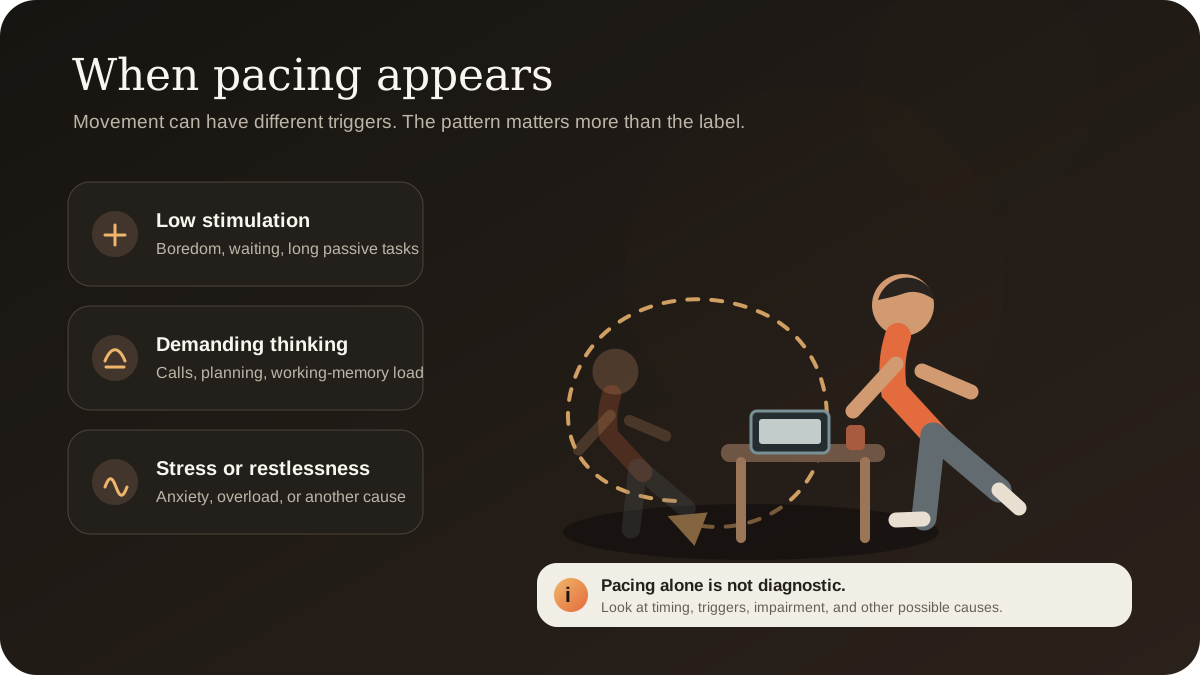
Three contexts that can coincide with pacing: low stimulation, demanding thinking, and stress or restlessness. Pacing alone is not diagnostic.
What is the difference between pacing, fidgeting, and exercise?
These terms get blurred together online, which makes the evidence sound stronger than it is.
- Pacing is repeated walking, often back and forth or around a small area. It is a plausible form of adult restlessness, but it has rarely been studied as its own ADHD intervention.
- Aimless walking means walking without a destination, sometimes while thinking or decompressing. It may overlap with pacing or a movement break; the reason and context matter more than the label.
- Fidgeting covers smaller, repetitive movements such as foot tapping, rocking, doodling, or shifting position. Several studies link naturally occurring fidgeting with task demands and, in some samples, better performance.
- Exercise is planned physical activity that raises effort or heart rate. It has a separate intervention literature and should not be used as proof that pacing has the same effects.
A study about ankle movement during a computerized attention task does not prove that walking circles around a room improves a work presentation. A trial of aerobic exercise does not test spontaneous pacing. Keeping those distinctions intact gives us a more honest answer.
Why might pacing show up during thinking?
Cognitive demand can bring out more movement
Working memory is the mental workspace used to hold and manipulate information. You use it while following a multi-step instruction, arranging a sentence, doing mental arithmetic, or keeping track of a conversation.
In a controlled study of 35 adults, including 20 adults with ADHD, participants moved more during working-memory tasks than during lower-demand control conditions. The ADHD group also showed more motor activity than the comparison group. The researchers concluded that working-memory demands contributed to the elevated movement, although some activity occurred independently of those demands (Hudec et al., 2014).
A larger 2024 study measured movement in 184 children while they completed executive and non-executive tasks. Children with ADHD had a higher baseline activity level, but working-memory and inhibition demands produced additional increases beyond that baseline (Kofler et al., 2024). This points to at least two contributors: some movement is present across situations, and some rises when the task asks more of executive control.
The broader literature shows the same context dependence. A 2016 meta-analysis of 63 studies using mechanical movement measures found larger ADHD–comparison differences during high cognitive load, high executive-function demand, and relatively low-stimulation conditions (Kofler et al., 2016). That finding explains when movement differences are most visible; it does not show that the movement is beneficial or consciously chosen.
That pattern helps explain why someone might sit comfortably while watching an engaging film but start circling the room during a difficult phone call. It is an explanation to test, not a diagnostic shortcut.
Movement may sometimes accompany better performance
The strongest evidence comes from small laboratory studies, and the wording matters: movement was associated with better performance. Researchers did not establish pacing as a treatment.
In a 2015 study, 29 boys with ADHD and 23 typically developing boys completed phonological working-memory tasks across four sessions. Within the ADHD group, higher naturally occurring activity predicted better, though still not fully normalized, working-memory performance. The opposite pattern appeared in the typically developing group (Sarver et al., 2015).
Another study followed movement trial by trial in 44 children and adolescents completing a cognitive-control task. More intense movement was associated with correct responses in the ADHD group, while that relationship was not found in the comparison group (Hartanto et al., 2015).
Adult evidence is newer. A 2024 study used wrist and ankle sensors while 70 adults with ADHD completed a Flanker task. Participants fidgeted more during correct trials, and adults with more consistent reaction times showed more fidgeting later in the task. The authors described a possible role in sustaining attention, while explicitly noting that alternative explanations remain (Son et al., 2024). The study had no non-ADHD control group and measured fidgeting during one laboratory session. It did not test pacing or a prescribed movement break.
Together, these studies make one idea plausible: for some people with ADHD, suppressing every movement may remove something that helps them stay engaged. They do not justify the stronger claim that more movement always produces better focus.
Is pacing a form of arousal regulation?
Possibly. Arousal in this context means the brain and body's level of alertness and readiness to respond. It is not limited to anxiety or excitement. Attention often suffers when activation is too low, too high, or unstable.
One influential model proposes that some ADHD behavior reflects difficulty reaching and maintaining a useful activation state. Movement and stimulation could then act as attempts to adjust that state. A 2018 resting-EEG study compared 33 adults with ADHD with 35 matched controls and found lower average vigilance and less stable arousal regulation in the ADHD group (Strauß et al., 2018). A 2024 review describes this state-regulation account as a serious but still debated complement to executive-function theories (Isaac, Lopez, and Escobar, 2024).
This does not mean every person with ADHD is chronically "under-aroused," or that every pacing episode is the brain correcting a dopamine shortage. ADHD is heterogeneous, arousal findings vary across studies, and the movement studies do not directly measure dopamine release. Claims that each lap around the room delivers a predictable neurochemical boost go beyond the evidence.
A safer summary is:
Pacing may provide sensory and motor stimulation that helps some people maintain alertness or organize thought, but the mechanism and benefit vary by person and situation.
Is aimless walking the same thing as ADHD pacing?
Sometimes it looks the same from the outside. Internally, the experiences can be different.
Aimless walking might be:
- automatic movement during a phone call or hard thinking
- a response to boredom or low stimulation
- a deliberate break after sitting for too long
- a way to discharge stress
- avoidance of a task that feels unclear or aversive
- ordinary walking with no clinical meaning
The outcome helps distinguish a useful pattern from an unhelpful one. If a brief walk makes the next action clearer and you return to the task, it may be functioning as a reset. If you keep walking while the task becomes more remote, the movement may be part of avoidance. If pacing feels compulsory, distressing, or impossible to stop, that deserves a different response than a casual thinking habit.
When can movement help, and when does it get in the way?
Movement is more likely to be useful when it has a job:
- keeping your body occupied during a listening-heavy call
- raising alertness during a monotonous task
- creating a clean break between two work blocks
- helping you rehearse or organize language aloud
- interrupting a long period of sitting before attention fades further
It becomes less useful when it creates a second task. Navigating traffic, checking a phone while walking, choosing music, or wandering into a distracting environment can consume the attention the movement was supposed to support. Pacing can also disturb other people or become physically uncomfortable.
The practical goal is not maximum movement. It is enough movement to support the task without replacing it.
A simple way to test whether pacing helps your focus
Treat this as observation, not treatment. Do not change medication or ignore clinical advice based on a self-test.
For your next several episodes, record four things when you notice pacing or aimless walking:
- Trigger: What were you doing just before you started moving?
- State: Were you bored, sleepy, stressed, overloaded, or thinking hard?
- Duration: Roughly how long did you move?
- Outcome: Did you return to the task, understand it better, or avoid it longer?
Use one simple outcome that matters to you. Good examples include time to restart, whether you completed the next concrete step, or whether you retained the main points of a call. Avoid rating the movement only by whether it felt productive.
After several observations, look for patterns:
- If pacing appears during verbal thinking and improves recall, try taking audio-only calls while walking safely.
- If it appears after 30 minutes of desk work, schedule a brief movement break before attention collapses.
- If it begins when a task is vague, write the next physical action before you walk.
- If it consistently delays re-entry, shorten the route and use a timer.
This is more informative than deciding that all pacing is either a symptom to suppress or a focus hack to encourage.
A practical movement-to-focus reset
A bounded reset can preserve the useful part of movement without letting it absorb the work session.
- Write the next action in one sentence.
- Walk or pace for two to five minutes in a safe, low-distraction space.
- Keep the problem with you by rehearsing the sentence, recording a voice note, or thinking through one question.
- Stop at the timer and return to the written next action.
- Check whether you restarted more easily than you would have without the break.
If you are alert after moving but your attention is still scattered, a short fixed-point exercise can provide a different kind of reset. Sit or stand comfortably, look at a neutral dot for 60 to 90 seconds, and notice each drift without forcing your eyes. The idea is to shift from diffuse movement to one chosen target. No trial has tested this sequence for ADHD, so use it as a personal workflow experiment rather than a clinical protocol.
For the evidence and limitations around gaze practice, read Trataka for ADHD: what the evidence actually supports. If the main problem is carrying one task into the next, the attention-residue reset is a closer fit. Neither practice replaces established ADHD care.
When should pacing be checked by a clinician?
Pacing is worth discussing with a healthcare professional when it is new, intense, distressing, unsafe, or interfering with sleep, work, or relationships. It also needs prompt review if it begins after starting a medication or changing a dose.
One reason is akathisia, a movement disorder most often associated with certain medications. It involves strong internal restlessness and a difficult-to-control need to move, which can appear as pacing, rocking, or shifting weight. Cleveland Clinic advises contacting a provider when these symptoms appear, especially after a medication change (Cleveland Clinic). Do not stop a prescribed medication on your own.
A clinician can also consider anxiety, mood episodes, sleep problems, substance effects, pain, thyroid or other medical conditions, and whether ADHD symptoms were present before age 12. The NIMH overview explains why persistent symptoms, impairment, childhood history, and alternative causes all matter in an assessment.
What the evidence supports and what it does not
The current evidence supports these statements:
- Restlessness and fidgeting can be part of adult ADHD.
- People with ADHD show measurable differences in motor activity at a group level.
- Cognitive demand can increase movement.
- In several laboratory samples, naturally occurring movement was associated with better performance.
- Arousal regulation is one plausible model for why movement occurs.
It does not yet support these claims:
- Pacing alone indicates ADHD.
- Every person with ADHD focuses better while moving.
- Deliberately pacing treats ADHD.
- Pacing and aerobic exercise have interchangeable effects.
- A specific dopamine explanation has been proven for an individual's pacing.
That boundary is the useful answer. Movement may be functional without being universally beneficial, and a behavior can be associated with ADHD without being unique to it.
Frequently asked questions
Is pacing a sign of ADHD in adults?
It can be one expression of adult restlessness or hyperactivity, but it is not specific to ADHD. Diagnosis requires a broader, persistent pattern that began in childhood, occurs across settings, and causes impairment. Anxiety, sleep problems, medication effects, and other conditions can also cause pacing.
Why do I pace while talking on the phone?
A phone call places demands on verbal working memory while leaving the body relatively unoccupied. Research shows that working-memory demands can increase motor activity in adults with ADHD. That makes pacing during calls understandable, but no study has established one universal reason for the behavior.
Can pacing help someone with ADHD focus?
It may help some people in some situations. Laboratory studies have linked naturally occurring movement with better working-memory or cognitive-control performance in ADHD samples. The evidence is associative and does not prove that prescribed pacing improves everyday focus.
Is pacing a form of stimming?
Some people use "stimming" broadly for repetitive movement that changes sensory input or internal state. Under that definition, pacing can function as a stim. The term does not explain the cause by itself, and similar repetitive movement can occur in ADHD, autism, anxiety, medication-induced restlessness, or without a diagnosis.
Is aimless walking good for ADHD?
Walking can be a useful movement break, but "aimless" is not automatically beneficial. Judge it by what happens next. If a short walk improves re-entry or clarifies the next step, it may be useful. If it extends avoidance or becomes unsafe or distressing, change the setup or seek help.
Should I stop a child with ADHD from moving while working?
Do not assume that stillness equals attention. Some child studies found better performance at higher naturally occurring activity levels. Movement still has to be safe and workable for the setting. Families and schools should make accommodation decisions with the child and qualified professionals rather than applying a universal rule.
Primary sources and guidance
- CDC. ADHD in Adults. Updated 2026. Read the guidance
- Son HM, et al. A quantitative analysis of fidgeting in ADHD and its relation to performance and sustained attention on a cognitive task. Front Psychiatry. 2024;15:1394096. PubMed | Full text
- Kofler MJ, et al. Is hyperactivity in children with ADHD a functional response to demands on specific executive functions or cognitive demands in general? J Psychopathol Clin Sci. 2025. PubMed
- Kofler MJ, et al. Hyperactivity in attention-deficit/hyperactivity disorder (ADHD): Impairing deficit or compensatory behavior? Clin Psychol Rev. 2016;46:45-60. Full text
- Hudec KL, et al. Working memory contributes to elevated motor activity in adults with ADHD. J Atten Disord. 2014;18(4):357-368. PubMed
- Sarver DE, et al. Hyperactivity in ADHD: impairing deficit or compensatory behavior? J Abnorm Child Psychol. 2015;43(7):1219-1232. PubMed
- Hartanto TA, et al. A trial-by-trial analysis reveals more intense physical activity is associated with better cognitive control performance in ADHD. Child Neuropsychol. 2016;22(5):618-626. PubMed
- Strauß M, et al. Brain arousal regulation in adults with ADHD. Psychiatry Res. 2018;261:102-108. PubMed | DOI
- Isaac V, Lopez V, Escobar MJ. Arousal dysregulation and executive dysfunction in ADHD. Front Psychiatry. 2024;14:1336040. Full text
- NIMH. Attention-Deficit/Hyperactivity Disorder: What You Need to Know. Read the guidance
- Cleveland Clinic. Akathisia: What It Is, Symptoms, Causes and Treatment. Read the clinical overview
Related reading
- Compare movement with other evidence-backed ADHD focus exercises.
- If getting started is the bottleneck, see how body doubling can provide external structure.
Last updated: August 10, 2026